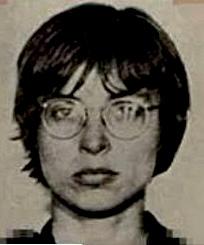
Diana Oughton was a 1960s era Communist revolutionary and domestic terrorist. Like most Communist revolutionaries from Vladimir Lenin to Fidel Castro, Diana too was from a wealthy family and a member of the upper class. Diana was an emotionally troubled girl who were she allowed her druthers, those of the upper class from which she came, would have been dispossessed of their wealth and likely executed- including her own family.
Diana’s classmates from the Marxist nursery Bryn Mawr College, seemed to remember her as a “frothy” socially awkward lightweight. The UPI also mentions her being labeled a “scatterbrained” student by her college classmates. Yes, Diana was mocked by her fellow students as a silly soul who lacked serious depth but, at least her college classmates at the Leftist cadre school possessed the collective decency not to ridicule her to her face. Unfortunately if so,, such polite discretion was likely not exercised by the children young Diana Oughton went to school with during her adolescence in rural Illinois.
At first glance, Diana Oughton seemed an unlikely candidate for being ridiculed or bullied by her classmates in grade school. Diana came from one of the wealthiest families in Illinois. Her family’s holdings during her youth included some 6,000 acres of corn and soybeans, a successful restaurant, and part ownership of the family bank in Dwight. Among the people of rural Dwight, Illinois, the Oughton family was at the top of the social hierarchy. Her classmates came from families whose values were similar to those of herself and her family- devout Christians and conservative Republicans.
Yet her strange psyche which would one day lead her to tear herself away from her close-knit conservative family in pursuit of overthrowing the United States government as a Communist Revolutionary, was likely the very source of her presumed social difficulties in school. Awkward children from wealthy families are often targeted by school bullies out of resentment, envy and norm enforcement. Yet, instead of seeking help and looking inward for whatever had to have been troubling her, young Diana apparently attributed her life’s challenges to things which had little bearing on her situation such as her family wealth, privilege, her Christian faith, conservatism and ultimately our free enterprise (Capitalist) system. Sometime thereafter, she would not only reject these values but later dedicate her life to their destruction. In so doing, she set in motion a series of disastrous events fueled by her own horrific mistakes in judgement which would have tragic results for herself and others.
Despite whatever personal troubles she may have experienced in class and the record is murky at best after some seventy years, Diana finished high school with a strong academic record. She could have attended any college or university open to women at the time. In the end, Diana Oughton insisted on attending the infamous women’s college, Bryn Mawr- a finishing school for aspiring Marxists girls with no shortage of prominent Communist women among its alumnae. Diana graduated from Bryn Mawr College in 1963. It’s difficult to tell how well she did academically as Bryn Mawr doesn’t issue letter grades. What is clear is that she likely left the college as a full-fledged Marxist.
After graduating, Diana linked up with the Leftist, American Friends Service Committee (AFSC) and spent two years “working” with impoverished villagers in Guatemala to build a “sustainable world free of violence, inequality, and oppression.” Typical Communist drivel. Communist have always used these or similar words to conceal their real objectives which have repeated throughout history, involved mass murder and/or imprisonment of political opponents, while also eliminating basic freedoms through a one party totalitarian government. Ms. Oughton and her cohorts were being sent to Guatemala if for anything, to indoctrinate the hapless rural peasantry.
The AFSC had long since replaced the pacifist Quaker theological doctrine of its founding for a collectivist, Marxist worldview which supported violent and genocidal governments and movements over their victims. Later, during the 1970s, the AFSC defended Cambodia’s Khmer Rouge, even after it had become incontrovertibly clear that the Khmer Rouge had murdered more than one million of its own citizens. Diana would later duplicitously explain away her conversion to revolutionary Marxism to her family, by describing the profound inequality and poverty she witnessed in Guatemala. Yet, she was very probably already a bona fide Communist before ever arriving in Guatemala. It’s more likely that she traveled to that third world country not to learn about the poverty experienced by rural tribespeople but instead, to radicalize them with communist revolutionary ideology.
After returning to America in 1965, Diana worked as a “Community Organizer” in Philadelphia. What a surprise! The following year, she enrolled in graduate studies at the University of Michigan in Ann Arbor. There she met the infamous future Weather Underground Organization (WUO) leader, Bill Ayers. The WUO was an overtly Marxist Revolutionary group with the professed objective of creating a revolutionary party to overthrow the United States government. The WGO was formed by Marxist hardliner Ayers and others including Diana Oughton, who wished to break away from the marginally less extreme and deceptively named “Students for a Democratic Society.”
In 1969 WUO members including Diana Oughton, paid a covert visit to America’s primary enemy in the hemisphere, Communist Cuba. In addition to meeting with Castro, they also met with representatives of the North Vietnamese government whom the US was actively fighting in a war, in order to coordinate so-called “global anti-imperialist campaigns.” Good girl! Good girl!
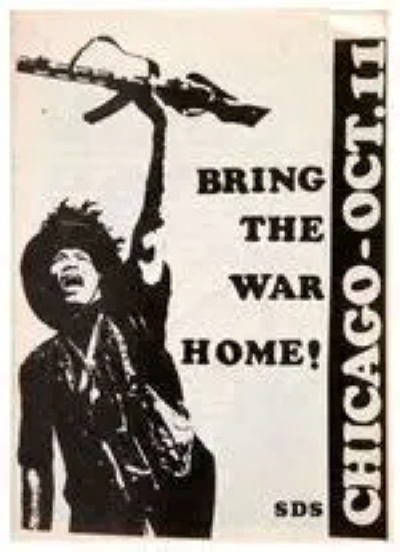
Buoyed after their successful meeting with the Communist representatives from Cuba and North Vietnam, the WUO planned and then initiated its most audacious move of the time, the Days of Rage offensive planned for Chicago to occur from October 8-11, 1969. This revolutionary offensive was intended to be the WUO’s magnum opus. The revolutionary operation was conceived to coincide with the trial of the “Chicago Seven.” The poster advertising the event was emblazoned with a picture of a Viet Cong soldier thrusting his AK-47 rifle triumphantly upward. The slogan on the poster was “Bring the War Home.”
The strategic objectives of the Days of Rage offensive were as follows:
- Bring the War Home. This primary objective was to initiate violent civil unrest in their area of operations which the WUO hoped would cause spontaneous civil unrest in other parts of Chicago and elsewhere in the United States. The Days of Rage offense was intended ultimately to spark armed civil warfare throughout the major urban centers within the United States. This was to be the WUO’s equivalent the “February Revolution” protests in Petrograd, Russia, commenced on February 23, 1917, and which caused the Tsar to abdicate while setting the stage for the Bolsheviks to seize power later that year.
- Demonstrate Military Tactics. This objective called for the abandonment of peaceful protest in favor of armed military street combat to demonstrate their soldierly fighting capabilities.
- Align with Global Revolutionaries. This aim involved working in concert with international Communist governments to disrupt U.S. infrastructure.
The WUO was expecting up to 25,000 hardened protestors to show up ready for armed conflict on the Days of Rage kick-off. Instead, a paltry 200-300 communist insurrectionists who answered the call arrived on October 8, 1969. This demoralizing and insignificant showing spelled doom for the operation and likely knocked the wind out of young Diana Oughton’s sails. Nevertheless, WUO leader Bill Ayers an otherwise brilliant revolutionary tactician, like the commander leading the doomed charge of the Light Brigade, ordered the offensive to proceed.
Rather than using their firearms, the protestors initially utilized pipes, bricks and clubs to smash storefront windows and clash with the police. Yet alas, the police and federal authorities were ready for the revolutionaries, and the cops and federal agents seemed to outnumber the protestors.
In short, the overly ambitious Days of Rage offensive was quickly contained and ultimately crushed by the authorities. Days of Rage became the WUO’s operational failure equivalent of the Battle of Little Big Horn. Well over 200 protesters were arrested, which comprised the vast majority of the revolutionary participants in the ill-fated venture. In addition to Diana Oughton, other prominent leaders within the WUO were also arrested including Kathy Boudin- another Bryn Mawr Communist girl, Cathy Wilkerson and Ayers’ lieutenant, Bernardine Dohrn. Diana Oughton’s arrest occurred on October 9, 1969, and she was able to post bail only after being processed in the Cook County jail where a full set of her fingerprints or “prints” were taken. This routine booking procedure would play a role in her final chapter with the WUO.
Not long after the disastrous Days of Rage offensive, the WUO decided to go underground and become a small-scale paramilitary operation carrying out armed urban guerrilla warfare against the “imperialist United States government.” The WUO split into several underground cells throughout the country. These cells usually comprised three to five men and women living together in a house. Diana Oughton shared an upscale townhouse in the Greenich Village section of Manhattan, with WUO cell members Kathy Boudin, Terry Robbins, Cathy Wilkerson and Ted Gold. The residence was owned by Cathy Wilkerson’s wealthy father. Oh, those snotty rich kids!
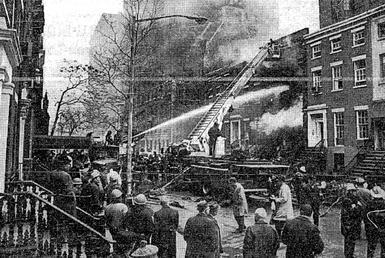
This cell of WUO Marxist revolutionaries had turned the cushy bourgeois Greenich Village townhouse into what police later described as a “bomb factory.” The cell began to work around the clock making bombs laced with nails and other shrapnel to cause the maximum amount of damage to their intended targets. They had scheduled a daring attack on a Fort Dix ball for Army Noncommissioned Officers and their families scheduled for the evening of March 6, 1970. The WUO cell members were intent on murdering as many of these U.S. Army Sergeants and their families as possible. The bomb making operation continued through the evening of March 5, 1970, and into the early morning of March 6, 1970- the date of the planned attack to occur that evening.
The WUO member tasked with making the antipersonnel bombs that morning was none other than Diana Oughton, the upper-class debutant from a prominent Illinois family. The problem was that neither Ms. Oughton nor the other WUO cell members in the house had any type of experience in making bombs. As Diana nervously assembled these lethal bombs, placing timers and blasting caps on bundles of TNT, a likely accidental trigger occurred during the handling and assembly of these volatile explosives which caused a detonation.
The explosion, the largest in New York City’s history at that time, destroyed the four-story townhouse and severely damaged neighboring buildings, including the homes of actor Dustin Hoffman and theater critic Mel Gussow. Diana Oughton, Ted Gold, and Terry Robbins were killed instantly. It took days of digging through the debris to find the various pieces of their remains which were unrecognizable. However, investigators found the intact severed finger of a young woman. They took the fingerprint and sent the print to the Chicago Police department for a possible match with any of the WUO members arrested during the October 1969 Days of Rage protest. The fingerprint matched the sample taken from Diana Oughton when she was booked into the Cook County Jail.
What little there was of Diana Oughton’s remains were sent back to her family in Dwight, Illinois. At the March 18, 1970, funeral, the local high school principal, speaking of Diana Oughton’s father’s feelings, said, “Jim (Oughton) always felt as if she already died once. She was off in a far place, and he just didn’t know why.”
“I think it was an idealism gone astray—she wanted to make a better world, as she knew it,” said an uncle who also said he knew her “quite well, except for the last five years— she sort of dropped out of our world.”
Ms. Oughton was a wholly misguided young soul who made dreadful life choices and who was likely plagued by serious psychological problems. However, her death of many years ago, is a tragedy which none of us should take delight in. Still, this sad event likely spared the lives of the Ft. Dix Sergeants and many of their family members. Further, the horrific and fatal townhouse explosion caused what little remaining support there was for the WUO to evaporate and ultimately, led to the terrorist organization’s demise. These are good things.

