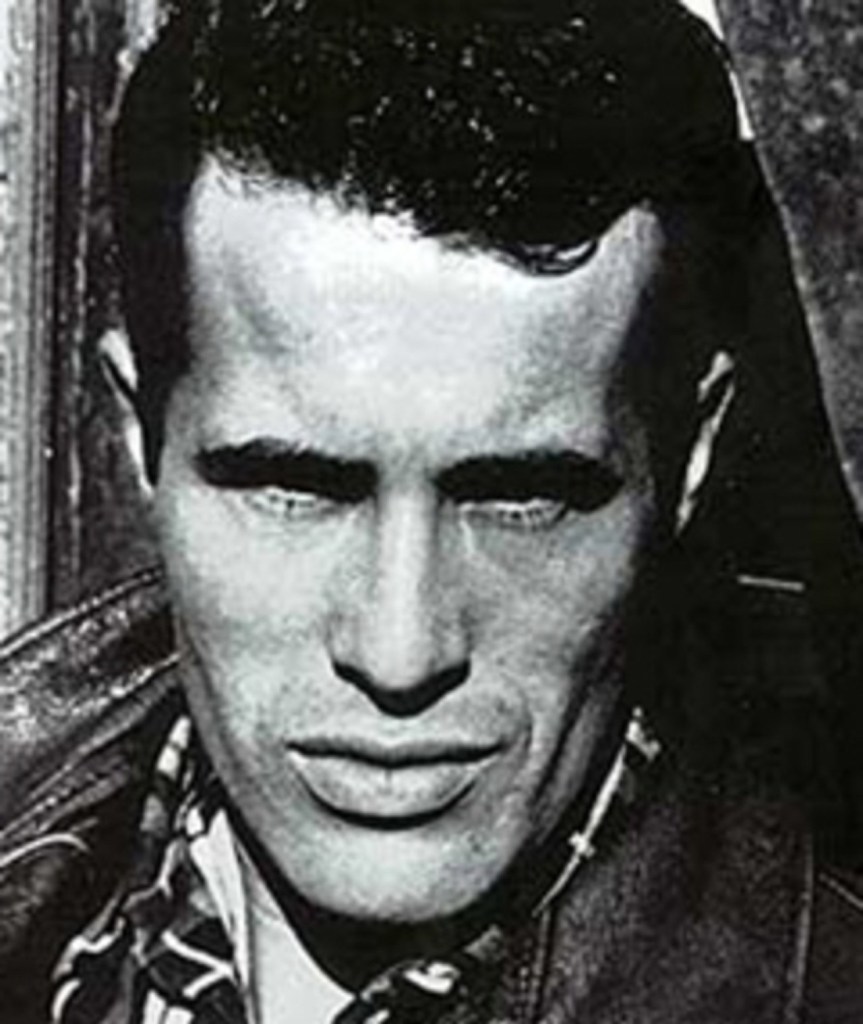
Kenneth Anger (1927-2023) was a gay underground filmmaker. He was also handsome, talented, cultured, intelligent, erudite, petty, narcissistic, prickly, rude, antisemitic, racist and a card-carrying Satanist as well as a prolific if not a pathological liar. When he died in 2023 at the age of 96, he hadn’t made a real film of any kind since Richard Nixon was President- over 50 years prior. So, the logical question follows, why is this guy celebrated by anyone?
Anger made only silent movies (no dialogue, just musical scores). His films were chalked with homoerotic, and Satanic themes as well as at times, Nazi imagery and symbols. He seemed to have had a gay fetish over muscular Nazi uniformed men, clad in black leather. I wonder if anyone had ever bothered to tell Mr. Anger that, had he lived in Nazi Germany and flaunted his homosexuality there as he did in America, some predatorily grinning, jack-booted, Nazi thug would have slapped a pink Star of David on his lapel and tossed him into the first open railroad cattle car destined for Treblinka?
So, let’s begin by addressing Mr. Anger’s racism and bigotry. Anger glorified Nazism in his peculiarly weird film, Scorpio Rising (1964) and others. When challenged on this, he upped the ante by making antisemitic remarks which are unfit to print here and further stated that, “on black people, I’m somewhere to the right of the KKK.” Anger was known for his antisemitic tirades. He paid the price for this once after going on a drug fueled antisemitic rant in Manhattan’s gay West Greenwich Village one evening the 1980s. His diatribe reached the ears of the wrong Jew who pummeled Anger in response. Yet, the brutal ass whipping Anger suffered would do little to deter him from making future antisemitic and racist outbursts.
“Oh, what a tangled web we weave when first we practice to deceive.” Sir Walter Scott.
Let’s face it, we all tell lies at some point in our lives. Sometimes the lies we tell are big. Sometimes they’re small little “white lies.” As for Kenneth Anger, he had a history of telling some real whoppers. Especially so, when those lies could advance his career or reward him financially. By way of example, for most of his life he claimed to have played the role of the Changeling Prince in the major 1935 Hollywood film, A Midsummer Night Dream. Yet all associated with this motion picture who were still alive, refuted these claims. The Film’s production records including daily cast calls, time sheet logs and payroll ledgers all dispute this as well. In reality, the role of the of the Changeling Prince was played by child actress Sheila Brown. Confronted with this, Anger still refused to back down and falsely insisted to his dying day, that he played the role when he obviously did not.
If at first you don’t succeed, lie, lie again. In order to dig himself out of a financial hole, Mr. Anger wrote a book titled Hollywood Babylon (1959). The book seemed to consist primarily of unfounded rumors and yarns Anger had heard over the years, in Hollywood’s gay drinking establishments and on the bath house circuit. There would be one follow up book that was published in 1984 titled Hollywood Babylon II. Both books were full of sensationalist lies and made-up anecdotes. In its review, the New York Times said of it, “If a book such as this can be said to have charm, it lies in the fact that here is a book without one single redeeming merit.” The Daily Beast described Anger’s book as “essentially a work of fiction.” There is no doubt that many—if not all—of the stories Anger shares in his slim bible have no merit.” Film historian Kevin Brownlow repeatedly criticized the book, citing Anger lies by writing that his research appeared to have been done through “mental telepathy, mostly.”
Both books resulted in lawsuits from various celebrities named in the works. Despite this, Anger was able to secure a publisher for Hollywood Babylon III which was scheduled to be published in 2015. However, that publisher backed out and refused to print the work as Kenneth Anger couldn’t substantiate the sensationalist claims he had made in his manuscript. Further, the publisher was receiving litigation threats from law firms representing Tom Cruise and other Hollywood heavyweights. Throughout his life, Anger demonstrated an enthusiastic willingness to lie and an overarching propensity to exploit the shortcomings and tragedies of others. The Hollywood Babylon series of books were not his first nor last attempt to do so.
A little exploitation with your coffee, Mr. Anger? While filming Scorpio Rising (1964) Anger was shooting some “B-roll” of a 1963 motocross race. Then, right before his camera lens, a motorcyclist took a turn too sharply causing him to be thrown from his bike where he landed on his shoulder and neck as his family and friends looked on in horror. He likely died instantly. Yet Anger was giddy over the unanticipated development. Anger saw an opportunity to exploit the recorded death of this man à la the later unrelated film, Faces of Death (1978) made by John Alan Schwartz. This, in order to gain a larger audience for his movie. The hapless motorcyclist was not part of the motorcycle gang which Anger was documenting in his film, and he was in no way related to the film’s theme or plot. He was only included in the picture because he died, and because his death was inadvertently captured on Anger’s 16mm motion picture camera. Today, this unfortunate man’s children have the ability to relive their father’s horrific death- with the footage remastered in clear, vivid color. How classy of you, Kenneth. In response to the heavy criticism over using the man’s death in his film, Anger callously retorted, “Look, I’m sorry the guy died but, it’s not like I tripped him.”
Anger was all too happy to work with part-time musician and full-time Charles Manson “family member,” Bobby Beausoleil. Beausoleil was doing a life sentence in a California penitentiary for the 1969 murder of a small-fry drug dealer and UCLA PhD candidate, named Gary Hinman who was also a “friend of the Manson family.” In fact, Kenneth Anger was known by the Manson family as well, and he was on friendly terms with Bobby Beausoleil, who occasionally supplied Anger with drugs.
At Gary Hinman’s home on July 27, 1969, Charles Manson got the homicidal party started when he lopped off one of Hinman’s ears with a sword. He then exited the “scene” and left Beausoleil to kill Hinman with the assistance of a couple of female family members- Susan Atkins and Mary Brunner. Hinman died an anguishing, torturous death. As he was being mortality stabbed multiple times by Beausoleil, Hinman began reciting a Buddhist chant. This seemed to only fuel the bloodlust of Beausoleil and his cohorts Atkins and Brunner, who all took turns smothering Hineman with a pillow until he finally died.
After Hineman passed into the hereafter, one or more of the Manson family threesome, gruesomely used his blood to write slogans on the wall similar to what Manson family members would later do the following month, during the Tate-LaBianca murders. None of this appeared to bother Kenneth Anger in the least.
Anger was working on his own personal magnus opus in the early 1970s, Lucifer Rising (1972). At that time, Manson and his family were still as topical as ever. There were talk shows, documentaries, television interviews, magazine features and even motion pictures about the Manson family. Most people however, wouldn’t have had anything to do with Charles Manson or his sycophantic followers personally. However, the same could not be said of Kenny “Exploitation” Anger.
“What a great idea I have to get people talking about my upcoming film. I’ll use Manson family member Bobby Beausoleil to do the musical score from prison!” Anger never spoke these preceding words aloud but undoubtedly he harbored these very thoughts. To think otherwise, would be naivety personified.
There were only a thousand or so competent composers and musicians offering their services to score films at the time. Does anyone truly believe Anger went through the list and upon finding no composers to his liking, barked to his assistant, “To hell with Jerry Goldsmith and Henry Mancini! Get me that Manson family kid in prison for murder! Beausoleil is clearly the best man for the job!”
Kenny indeed offered the job to Bobby Beausoleil and in so doing, exploited the Manson family infamy to gain publicity for his film. His self-promoting gimmickry dishonored the Manson family’s victims and proverbially speaking, he spat in the face of those victims’ still grieving family members. Perhaps Anger chose Beausoleil to score his film only because Charlie Manson, also a musician, was unavailable due to his being on San Quentin’s death row at the time. As expected, there was an uproar from segments of the media and a sizable portion of the public voiced outrage over Anger’s collaboration with the convicted Manson family murderer.
Yet, apart from getting copious publicity for the film, there was no financial windfall for Anger. His type of iniquitous works were not deemed fit for screening in mainstream cinemas of the era, and the Television stations of the day wouldn’t have touched him or his revolting “art,” even while wearing rubber gloves.
The film garnered no money to speak of, and it was a financial disaster both for Anger and its luckless distributors. It would be Anger’s last real film. His swan song. Nobody was willing to give him so much as a dime for his film projects thereafter.
Bitter over the film industry’s rejection of him, Anger would express unhinged rage toward other so-called avant-garde filmmakers- particularly Andy Warhol. Anger frequently exhibited hatred and professional jealousy over Warhol’s success in the medium of unconventional filmmaking. In 1980, likely during a during what had to have been a drug-induced rage, Kenneth Anger went up to Warhol’s townhouse house in Manhattan and threw paint on the front door while screaming profanities directed at Warhol. The problem for Anger was that the house was vacant. Warhol had moved out the month before. Again, Kenny was a day late and a dollar short- a recurring theme throughout his life.
Kenneth Anger was an odd, snarky old queen who never seemed to have met a single soul that he didn’t look down on. Anger had about as much humor in him as one might expect to find in perusing the Warren Commission Report. He always seemed to have a derogatory little quip on hand about everyone he ever encountered in his life. Never willing to accept his place on the outermost fringes of Hollywood, he placed himself on high as the ill-natured Judge of every person of importance in the film industry and beyond. Yet, his own shortcomings of charter were almost always more profound than of those he criticized.
He had no friends to speak of, only those unfortunate people who came into his life and of whom he could use for money, a place to stay or for free drugs. His own siblings despised him and as Anger disclosed in a 2013 interview with The Guardian, his older sister Jean referred to him as the “BCA or Birth Control Accident” child. He died as he lived most of his adult life, financially broke. During the last two decades of his existence, he resided in a modest apartment in his beloved Hollywood, which was located at 5533 Hollywood Blvd, Apt 434, Los Angeles, CA 90028.
So, circling back to my original question, why is this guy celebrated by anyone? Why do certain young people today make this prolific liar, antisemite, bigot, racist, exploiter, and doper into a cause célèbre?
Perhaps it’s all as simple as Sun Tzu once wrote over 2,500 years ago, “the enemy of my enemy is my friend.” Mr. Anger made controversial, homoerotic films with Nazi and Satanic symbolism. All an anathema to the large conservative, Christian segment of the American society of his time and still today. The Left is always looking for allies and heroes in their war against American culture and its large conservative Christian element. In so doing they have been consistently willing to ignore the vilest of shortcomings in the people they make alliances with or in the case of Kenneth Anger, heroes of.
 The Historical Truth Project