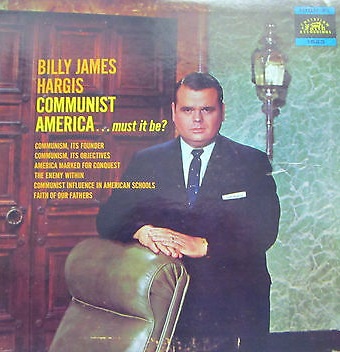
During the early 1960s, the New York Times reported that Reverend Billy James “Hargis appears to be on his way to rivaling the Reverend Billy Graham.” Yet at the time, millions of American evangelical Christians already considered him of equal stature to Graham. He was a household name. Reverend Hargis’ Christian Crusade program was broadcast daily on over 500 US radio stations and weekly on 250 television stations. Millions of Americans turned into his broadcasts. So, what happened?
Today, everyone knows who Billy Graham was. When Revered Graham died in 2018, condolences poured in from all over the world. American political leaders, Democrat and Republican alike praised his life and works. America mourned the passing of this “giant of a man.” However, Reverend Hargis died an obscure death in a Tulsa nursing home in 2004. There were the perfunctory newspaper obituaries yet, most people seemed to have forgotten who he was. Why? How?
It appears the good Reverend Hargis’ troubles began when he dared to begin criticizing Communism- both the Soviet state and its puppets as well as Marxism’s domestic purveyors. Isn’t taking on Communism a little outside the lane of a respected Christian evangelist? Shouldn’t he have just stuck to the Bible? Reverend Hargis felt not.
As a member of the clergy, Hargis was concerned by what he perceived as the rapid moral decline of our society in the early 1960s. He was vexed by the rising tide of illegal abortions, divorce, homosexuality, rampant drug use, pornography, and overall permissiveness coupled with attacks on our free enterprise system and Leftist infiltration of churches and seminaries. Hargis began investigating the people who were enabling these social ills. At every turn, he discovered that the path led back to either Communists, their fellow travelers or Communism’s reliably useful idiots on the liberal or progressive Left. Reverend Hargis was perplexed as to why these Communist influenced assaults on the moral fiber of our society weren’t being covered by the major American media outlets. Reverend Hargis felt that if the large media corporations wouldn’t cover these issues, he should use his sizable broadcasting platform to do so. That’s when his troubles began.
Hargis projected where all this burgeoning moral depravity would lead us as a society. He made a series of bold predictions which were mocked by the Left and their cohorts in the major media outlets. Hargis had the temerity forecast, based on where he saw our society heading, that one day in America:
- Abortion would be made legal by either the courts or federal legislation.
- Divorce would become widespread and there would be legislation to allow “divorce on demand.”
- Homosexuality would “come out of its closet and into the public mainstream.” Author’s Note: In a free society, we should not punish or discriminate against people over their sexual orientation.
- Pornography would be made legal by the federal courts.
- The death penalty would be abolished and or severely limited due to expanded appeal procedures.
- The drug problem would get worse, not better and become far more widespread.
- Leftist would continue to infiltrate the church to change Christian doctrine and create churches which advance Leftist goals.
- Television programming and Hollywood movies would ditch the Production Code and start making movies with nudity, sex, extreme violence with overtly anti-Christian themes and storylines.
- Leftist would continue to infiltrate public schools and would one day turn public schools and universities into centers for Leftist indoctrination.
- The major American media would ditch its pretense of fair and unbiased news and go all in to advance the Left’s objectives.
- Crime would rise to unseen levels, and it will become more violent and deadly than anything we’d ever before seen.
- The sanctity of human life would be cheapened.
- The Left would start a full-fledged assault on the sacred constitutional right of Americans to own firearms and to exercise self-defense.
- The federal government would one day become all powerful and, through its vast expansion and myriad programs, would exercise unprecedented control over our lives.
- Hargis also criticized America’s abrogation of its responsibility to defend democracy against the threat of Communism at home and abroad. He criticized the Kennedy administration’s failure to take out the Communist regime in Cuba and asserted that the United States was on track to shirk its responsibility to confront and subdue the Communist threat in Vietnam.
In the early 1960s, Hargis’ predictions were derided as laughable, dystopian conspiracy theories. At least so, until they all came to pass. Yes, Hargis read the proverbial tea leaves remarkably well. The question he pondered at the time of his predictions was, what would he should do to alert the American public of these concerns? Had he decided to avoid the subject and simply continued to preaching the Gospel of Jesus Christ, he would have would have been remembered today as an evangelist who enjoyed and storied career. However, Hargis was not the type of man to shrink from a fight, if he felt the cause was just.
Hargis would use his media empire, which reached millions, to shine the light of truth on what he saw as the “seedy, shadowy dark enclaves of domestic Communism’s campaign to subvert the traditional values of our society.” Initially, his actions proved successful. Millions of more people began to listen to his broadcasts and donations to his ministry increased significantly. However, not everyone was pleased. Hargis’ expanded media footprint caused the establishment media and certain liberal politicians to paint a target on his back. Were that not enough, the Reverend was not afraid to name names and drew the ire of both President Lyndon Johnson and his successor, Richard Nixon. This was risky new territory for Hargis as in the pre-Watergate era, US Presidents frequently used federal agencies such as the FBI and the IRS, to go after prominent citizens who were a threat to them. Reverend Hargis became the subject of an ongoing government campaign of harassment from the IRS, FBI and even the FCC. While there was never a basis for criminal charges, the political persecution of Hargis from these federal agencies continued for years.
At every turn, the government was there to pester Hargis with investigations, tax audits and civil court actions. None of this slowed the growth in his radio and TV audience. Hargis remained as popular as ever with Christian America. In the 1960’s he began a road show with American war hero, retired Army General Edwin Walker. The road shows proved particularly popular and others, outside of the Christian faith began attending. The message was Christianity combined with populist conservatism.
In the 1960s, the new mainline conservatism advocated by Barry Goldwater, William F. Buckley and Ronald Reagan was in its infancy. Populist conservatism as espoused by politicians such as Donald Trump, was almost non-existent. Hargis, like General Walker, was a populist conservative. In fact, Hargis is one of the founders of the movement. Populist conservatism would remain on the fringe of the Republican Party for many decades until the era of Donald Trump. In Hargis’ roadshow, which drew tens of thousands of Americans in every city they visited, became the genesis of what is now called “Trumpism.” Apart from Hargis and Walker, there were scarcely few others prominent leaders in the new populist conservative movement which blended evangelical Christianity, with anti-Communism and an “America First” agenda that was protectionist and anti-immigration. Sound familiar? It’s safe to say that without Reverend Hargis, we might never have known “Trumpism” today.
As Reverand Hargis’ audience continued to grow, he experienced setbacks from the government but nothing that would stop his message from resonating. Having not slowed Hargis’ movement with harassment, the government seemed to escalate its tactics to discredit Hargis and Walker. Before I go any further, I would urge you to watch the embedded video below. It’s a deleted clip from the Oliver Stone film JFK, which recounts the government’s efforts to lay a trap for prosecutor Jim Garrison by setting him up with a fabricated gay sex allegation in a public bathroom with police officers conveniently standing by to nab him.
Restroom Scene (Deleted) from the Oliver Stone film, JFK (1991)
This was a common method used to destroy the credibility of certain people whom the government deemed “troublemakers.” It was unsuccessfully attempted on New Orleans District Attorney Jim Garrison pretty much as shown in the clip above. The same method was used against WWII hero, General Edwin Walker in a Dallas public restroom. Just as in the clip, a bunch of police were waiting right there to arrest Walker after being framed for “lewd public conduct.”
After the incident with General Walker, Hargis traveled with loyal people around him at all times. By keeping witnesses next to him everywhere he went in public, Reverend Hargis seemed to have airtight protection against government dirty tricks. That is, until he didn’t. By 1974, Hargis served as the President of the American Christian College and Seminary in Tulsa, Oklahoma. Suddenly one day, like a lightning bolt out of the blue, two young students stepped forward and claimed that Reverend Hargis had forced them into sexual relations. The allegations were made by a female student as well as a male student. How convenient. That certainly covered all of the bases. Yet no one seemed more surprised over these claims than Reverend Hargis himself, who had been married for decades with three children. For his part, Hargis vehemently denied the allegations until the day he died. Whether the allegations are true or not, we’ll never know.
What we do know is that the Tulsa District Attorney did an exhaustive investigation into the case and found no criminal wrongdoing had occurred. No charges were filed. After a thorough investigation, both of the area newspapers, The Tulsa Tribune and The Tulsa World refused to even publish the mere accusations. Unfortunately, Reverend Hargis was tried in the court of public opinion by the national establishment media. This would lead to his ruination. Donations to his ministries dwindled. The media induced scandal finished him as an effective spokesperson for his cause.
Few today draw the connection between Trumpism and the political and religious crusades of Reverend Billy James Hargis. Yet, it’s likely that without Hargis, there would not be Trumpism today. At least not as we know it. Hargis’ lived his remaining years away from the spotlight. In many ways he died a broken man but, the political movement he started would come to fruition and become the predominant dogma of the Republican party.
Below is an interview with Hargis from 1979, on the popular national television program, the Tomorrow Show, hosted by Tom Snyder.
https://www.youtube.com/results?search_query=Tom+Synder+Billy+James+Hargis

 The Historical Truth Project