Herman “The Butcher” Marks: An American Deviant Sex Offender and Violent Career Criminal who became Castro’s Chief Executioner

   Herman Marks was born into a working-class family in Milwaukee, Wisconsin on August 1, 1921. Marks was a sexual deviant with an overriding compulsion to rape underaged girls- the younger the better, as he saw it. His propensity toward violent crime began in his early teens, and for the remainder of his life thereafter, he robbed, rapped, stole and brutally beat any hapless victim he could exploit when the opportunity presented itself. He was a loner and certified psychopath. When Herman was not committing violent felonies, he would drink, smoke, sniff, swallow or inject any illegal narcotic he could place his dirty little hands on. He had a grade school education and a creepy demeanor which repelled just about everyone he ever came in contact with. These credentials would later make him an ideal candidate for recruitment into Fidel Casto’s murderous, Communist guerrilla army in Cuba.

   His last prison stretch was in Wisconsin’s Waupun State Penitentiary. A prison which was then set aside for the most violent and hardened of Wisconsin’s criminals. Upon learning of his assignment to Waupun, Herman naively assumed that he would fit right in and make fast friends among his fellow deviants. Unfortunately, Herman wasn’t particularly well received by his fellow convicts in Waupun. This was primarily for two reasons: First, the other inmates found him to be a “weirdo” in the extreme. Second, it was learned by the offender population that Herman was doing time for the rape of a sixteen-year-old girl which caused Marks to be branded in prison slang, as a “Broad Jumper.” Even prison Warden, John C. Burke would later describe Herman Marks as, “a real stinker.” This was no small distinction given the many other notorious and profoundly disturbed prisoners who were also incarcerated at Waupun then.

   Marks acted like a tough guy when he was loose on the street brutalizing the elderly, women, teenaged girls and others weaker than him. In maximum-security prison, his tune changed. Once Marks’ profile was raised from his later activity in Cuba, journalists began seeking out interviews with those who knew him from before his nefarious deeds in service to Castro. One such person was Mathew “Matty” Brown who had served time with Marks in Waupun. Brown remarked:

 “He (Marks) didn’t look like a punk. I mean, he had a good build. But all fish (new inmates) get tested by other Cons. He wouldn’t stand up for himself. He was a strange cat. Odd…man. Very odd… you know? Something was wrong with him… yeah, he was a punk.”

   Perhaps only the infamous serial killer Ed Gein was hated more. Yet, Gein was housed in Waupun’s criminally insane ward, where the inmates couldn’t get to him. The same was not true for Marks. In Waupun, Marks quickly earned the nickname, “Frig Mouth.” In 1950’s prison slang, “Frig” means copulation. Need more be said? He survived two different attempts on his life from other inmates. Nothing about his difficult taste-of-your-own-medicine experience in Waupun changed his views on crime, criminality or the victims of the same. According to Herman Marks himself, it only reinforced his own personal ethos that, “…in this world there are only the strong and the weak. In nature, the weak are always victims of the strong or stronger.”  How philosophical.

   In 1956, Marks was released from the penitentiary.  He had no job prospects nor a girlfriend waiting for him when he got out. In fact, Marks had never had a girlfriend. Although Marks was not an unattractive man, he had never been much of a hit with the opposite sex. Marks’ freaky weird persona tended to cause the needle on women’s internal Creep Meters to shoot deeply into the red zone. This was likely because prison psychiatrists diagnosed Marks as being both severely narcissistic and psychopathic. Thus, when not raping young girls, Marks spent most of his limited financial resources on buying encounters with prostitutes in Milwaukee’s red-light district. Even with these ladies for hire, there were still those who balked- no matter what price Marks was willing to pay. Among Milwaukee’s “working girls,” Herman Marks would became known as “Psycho Eyes.”

   Marks’ release from prison in 1956, opened a host of fresh challenges for him. As it turned out, numerous people were eager to find Herman Marks so they could “talk with him.” Who were these people? Well, they included FBI agents, police detectives and other members of the law enforcement community from such far-flung places as New York, Maine, Michigan, Illinois, Indiana and more. All were keen to speak with Marks about serious crimes he was alleged to have committed such as, theft, armed robbery, burglary, assault, and of course, rape. Yet they were having difficulty finding him. This was only because when not snoozing on his mother’s couch, Marks had become a wandering street itinerant, sleeping wherever he could find a roof to have over his head. Word on the street regarding the different law enforcement agencies searching for Herman Marks, soon reached old “Frig Mouth.” Upon being apprised of the authorities’ efforts to find him, Marks deduced it might be wise for him to get as far away from Milwaukee as possible. There was just one problem. Mr. Marks had not so much as the proverbial pot to piss in, let alone the money needed to relocate to a far off region of the country.

   For most people, this would pose a significant obstacle. However, unlike most people, Marks would demonstrate a certain resourcefulness when faced with his dilemma. Accordingly, Marks did what any red-blooded American career criminal would do under similar circumstances. He stole a series of cars then went on a four-day, multi-state crime spree where he mugged, pillaged, robbed, burgled and stole until he had enough money to make his way south the Florida, which is almost as far from Milwaukee as one can get while still remaining in the continental United States. Once in Maimi, he went on a drinking, drugging and prostitute fueled binge of hedonistic depravity.

   In Florida, he had talked his way into a job working on a shrimp boat. He had done so by claiming to have served as a sailor in the US Merchant Marine. He lasted about three days on the shrimp boat until it became apparent that he didn’t know what the hell he was doing. There never was any definitive proof that he ever did in fact serve as a merchant mariner although Marks would continue to claim as much for most of his life.

He would also claim at various times that he had either served in the Army in WWII or during the war in Korea. These claims can be disproven. Although he was of military age during WWII, Marks had dodged the draft and was arrested and later charged with draft evasion. The draft evasion charge was dismissed as the Judge determined that his extensive criminal record would have precluded him from being eligible to serve in any branch of the US military. However, Marks was well versed in the use and maintenance of various firearms, going back to his childhood. His father was a bit of a gun nut. Those skills would later serve him well both as a criminal and in other future endeavors.

    It was in Miami where he made some newfound criminal friends who alerted Marks to opportunities for those with his particular skill set, in Havana. There were many Mafia controlled hotels, nightclubs and casinos to be found in Havana, Cuba and the mobsters who ran them were purportedly always looking for men who weren’t afraid of “getting their hands dirty.” With the remaining booty from his crime spree, Marks was able to secure boat passage to Cuba. Shall we generously say it was the type of travel arrangement which didn’t require Mr. Marks to present his Passport upon arrival.

   Marks made the rounds of the various mob owned casinos in Havana. He made less than a favorable impression on the Mafia operators. Marks had the type of repelling personality which caused others, including fellow criminals, to adopt an unflattering opinion of him. On his second day of job hunting, he visited The Hotel Plaza, a notorious Mafia owned casino in Havana. The assistant casino manager seemed to think Herman Marks might be a good addition to the of operation’s “muscle department.” Marks was invited back for a meeting with the man in charge of the operation, notorious mobster, Joe Stassi. After speaking with an excessively weird and cocky Marks for about ten minutes, Stassi saw right through his bullshit.  Having heard enough, Stassi stood up and warned Herman Marks, “I never forget a face, Pal.  You’d better hope I never see yours in this casino again.”

   Marks was escorted off the premises and given a final warning to never return. As Herman Marks gloomily walked through Havana’s Vedado District, he undoubtedly contemplated his limited prospects. By his own admission, he knew only ten words of Spanish. He was almost out of money but, he couldn’t return to the United States as he was a wanted man. Marks then did what was quite predictable for him. He beat a hasty path in search of an oceanfront dive bar with the intention of getting drunk.  

   Marks’ wild eyed and unkempt appearance was in stark contrast to the throngs of affluent American tourists he walked amongst in his search a cheap, hole-in-the-wall bar. He finally found a darkly lit, seedy little joint away from the tourists, that suited him and his limited budget. The clientele seemed to be mostly fishermen and sailors. Marks took a long swig from his ice-cold beer and contemplated the limited options available to him given the seemingly irrevocable corner his choices has painted him into.

  Yet in life, as one door closes, another may open. Just as Marks ordered a second beer with a shot of whiskey, he felt a warm pat on his shoulder.

  “Herman?” The voice which spoke with a Cuban accent and had a pleasantly surprised tone.

   Herman Marks turned to find one of his crewmates from the ill-fated Shrimp Boat job standing next to him in the bar. The Cuban was the only member of the small crew who had tried to help him learn his job. The other crew members had exhibited contempt for Marks as his lack of qualifications ultimately caused more work for them.

   As a man with few friends, Marks enjoyed his reunion with the Cuban sailor. The two men drank, joked and laughed for several hours. Marks had told his friend of his unsuccessful attempts to find work at the local casinos. His friend responded by telling him that those casinos wouldn’t be around for long in any event. The Cuban told his former shipmate about the 26th of July Movement. A revolutionary force which he felt would ultimately succeed in overthrowing the government of Cuba because the people were allegedly opposed to the régime of Fulgencio Batista.

  Marks asked the Cuban two questions: “Does the rebel army accept yanquis?” “Who would I see to join the 26th of July Movement?”

The next day, Marks purchased a bus ticket to the town of Manzanillo, which was then a sleepy little city nearly 500 miles to the east of Havana, nestled in the foothills of the Sierra Maestra mountain range. With nothing to lose, he decided to become a member of the Communist revolutionary army or die trying. Yet, the choice to join a Communist guerilla insurgency was a particularly odd decision for one Herman Marks.  

   Beginning in his late teens, Marks had developed a strong affinity for Adolph Hitler and the Italian Fascist leader, Benito Mussolini. He specifically agreed with Hitler’s warped racial dogma. He believed wholeheartedly that white people were a master race and viewed others of non-white ethnicity, particularly blacks, with disdain. He supported the idea of racial segregation and felt that as a white man, he should not have to suffer mingling with blacks. He considered Communism to be a sinister Jewish invention with the objective of world domination and Zionist supremacy. He also believed that Communism itself was a Jewish conspiracy to enslave the white race. In short, Marks was a despicable racist with a deluded if not perversely twisted, world view.  

   Upon arriving in Manzanillo, the man who believed that “Communism was the chosen vehicle of Jews to enslave the white, European race,” set out to ask anyone and everyone he encountered about how he would go about joining the Communist revolutionaries. It wasn’t long before Marks met two young Cubans who were also hoping to join Castro’s guerilla army. Marks and his two new companions decided to band together. They bought all the provisions that they could carry and set out into the jungle to find the rebels. After nearly three days and with their provisions waning, the trio of aspiring revolutionaries stumbled upon a guerrilla outpost

The jungle outpost was manned by a few dozen rebels and commanded by guerrilla Captain Paco Cabrera who, fortunately for Marks, spoke English. Captain Cabrera was initially suspicious of Marks’ intentions and taken aback by his strange demeanor. Cabrera spent a significant amount of time questioning the rather odd American. For his part, Marks spun some wild tales about his having served with distinction in the US Army during the Korean War where he claimed to have seen extensive combat. He also claimed to be a small arms expert. There was some truth to the latter statement as he had grown up using both pistol and rifle and was proficient in the cleaning and maintenance of many different firearms.

   Marks’ two companions were welcomed into the rebel army as was Marks, despite Captain Cabrera’s reservations. Marks’ new comrades in arms within the small jungle guerilla garrison didn’t know quite what to make of him. He couldn’t speak Spanish and exhibited some peculiar behavior such as frequently talking or laughing to himself. This strange behavior prompted his fellow guerillas to label him as the “Loco Gringo.” A derisive moniker yes, but preferable to “Frig Mouth.”

   Marks cachet among his fellow rebels improved considerably one day when he came upon a few of his fellow soldiers clumsily trying to disassemble a .30 Caliber M1 Carbine rifle. Newly minted guerrilla fighter Herman Marks intervened and showed his comrades how to properly disassemble, clean and maintain the weapon. Marks soon became responsible for the maintenance and repair of all firearms in his remote guerrilla base.

    Marks would later be assigned to a unit ostensibly commanded by Che Guevara. Guevera was not a skilled battlefield tactician and delegated the tactical combat deployment of men to his subordinates. In Marks, Che immediately recognized a kindred spirit. Both men were diagnosed with narcissistic personality disorder and both were Psychopathic. Both men avoided direct combat whenever they could, and both would become known as men who took great pleasure in executing other people.

   Yet, in his journal, Che wrote that, “The American (Marks) fundamentally didn’t fit into the troop.”

   Che’s guerilla underling and aid, Enrique Acevedo, told Che’s biographer, Jon Lee Anderson that Marks was, “tyrannical and arbitrary…in camp.” Acevedo also told Anderson that Marks’ “bloodthirsty ruthlessness had disturbed many of his fellow rebel fighters and that it was particularly his readiness to gleefully volunteer for execution duty which he did with an enthusiasm which was unseemly.”

   After the fall of Batista and the collapse of the Cuban government, Che would be tasked by Castro with overseeing the executions of close to 49,000 Cubans. Who were these unfortunate souls slated to be snuffed out by their new Communist masters?  They were those who had dared to serve in the Cuban military from the ranks of Private all the way up to General. Anyone who had ever served in the police force. Anyone of note who had previously criticized Castro or his revolution. Any wealthy individuals who hadn’t already fled the island.

    Che, like Herman Marks, was a psychopath, and a sexual degenerate. Although Comrade Che would have personally enjoyed executing all 49,000 Cuban “enemies of the people” himself, it was not feasible for him to do so. Accordingly, Che naturally chose his kindred spirit Herman Marks, to assist in this task. Marks, who had recently been promoted to Captain, was given command of the La Cabana fortress and tasked with overseeing the executions of tens of thousand of these former soldiers, policemen and critics of Castro.

  Thus, standing at center stage in the courtyard of the La Cabana fortress stood “Psycho Eyes,” also known as “Frig Mouth,” the Waupun Penitentiary “punk.” His evil, crooked smile beaming live on Cuban Television and before the international press while bellowing out the commands to the firing squad: “Atencion, Preparen, Aputen, Fuego!” (Attention, Ready, Aim, Fire!). After the lifeless bodies of the condemned collapsed to the stone masonry floor below, Marks would walk toward the executed men with the wicked grin of man who was thoroughly enjoying himself. Then, into each blood oozing corpse he fired a bullet into the head, which he appeared to relish.

    It’s believed that old “Frig mouth” presided over the executions of some 20,000 Cubans. Many of these executions were witnessed by the loved ones of the condemned on live television. Marks took great enjoyment in mocking those condemned men who called for a Priest to give them the Last Rites or who prayed to God before their execution. Many of the men were led to the execution courtyard with their hands untied. More than a few of those men used their last moments of life to courageously taunt their Communist tormentors. Many of these men would place their index finger between their eyes and courageously deride their executioners by shouting, “Aim right here.” In the end, it was the dignity of these condemned men which demonstrated their real courage. The type of courage which had always eluded men like Che or Marks.

    For the brave men who would dare the firing squad to “shoot right here,” (between the eyes) Marks would personally shoot each of these dead men in the face with six to eight bullets in order to ensure that their families would be unable to recognize them. Marks briefly became a worldwide celebrity among Leftists. He enjoyed the numerous media interviews where he would always mention how grueling his schedule was and seldom failed to mention that he was “up until 2:00 AM performing executions.” In the western media, Marks became known as “the Butcher Havana.”

    After all the “people’s enemies” were executed, Marks’ Warholian fifteen minutes of fame evaporated. Even Castro seemed ever so unnerved over how much Marks seemed to enjoy executing people. News stories had made their way into Cuba from the American press detailing Marks’ extensive criminal history and prison record. That portion of his past was conveniently left out of the biography he had provided to Castro. Moreover, there was no longer much use Herman Marks in the new Castro dictatorship. Marks could barely speak Spanish. He had no education and few skills to offer the new government apart from his willingness to murder others.  To his profound disappointment, he was offered no position of import in the new Communist regime. However, as a “hero of the revolution,” he was afforded a very small and modest home to live in and a meager monthly stipend to subsist on. Marks angrily scoffed at the offer.  He clearly had an inflated view of his own worth to Casto’s new government. In an enraged tizzy, “Frig Mouth” stormed out of Cuba and discreetly slipped back into the United States. He was arrested soon thereafter for illegally entering the country and there was a dispute over whether or not he was still a United states citizen which was settled in his favor by the courts. Marks quickly became a societal pariah within American society.

     He was unable to find gainful employment given his criminal record and status as “the Butcher Havana.” He was arrested in New York in May of 1964 for making threatening phone calls. On Friday the 13th of August 1965 he fell from a tree and broke his right leg after using binoculars to peep at a young girl through a neighbor’s window. When the police arrived, his trousers were unzipped, and an “appendage” was protruding from the unzipped pant zipper crotch. An arrest warrant was issued for Herman Marks after his return to Milwaukee. The warrant alleged that he had engaged in “indecent sexual behavior with a six-year-old girl. Upon hearing of the arrest warrant, Marks told others that he was, “getting the hell out of dodge.”

He was last seen speeding toward the state line via what today is known as “Interstate 39. “ He was never seen again. Different theories have arisen concerning his disappearance.

Some say he went to Las Vegas, seeking “muscle work” and ended up in a hole in the desert courtesy of John “Handsome Johnny” Roselli who also had CIA contacts and had worked with the agency on Cuban related matters. For a while, the father of the six-year-old girl that Marks had molested was considered a prime suspect in his “disappearance.” Others have alleged that Marks was tortured and killed by Cuban exiles. What seems almost certainly to be the case is that a person or persons unknown did our society and the world at large a tremendous favor by dispatching “Frig Mouth” to Hell.
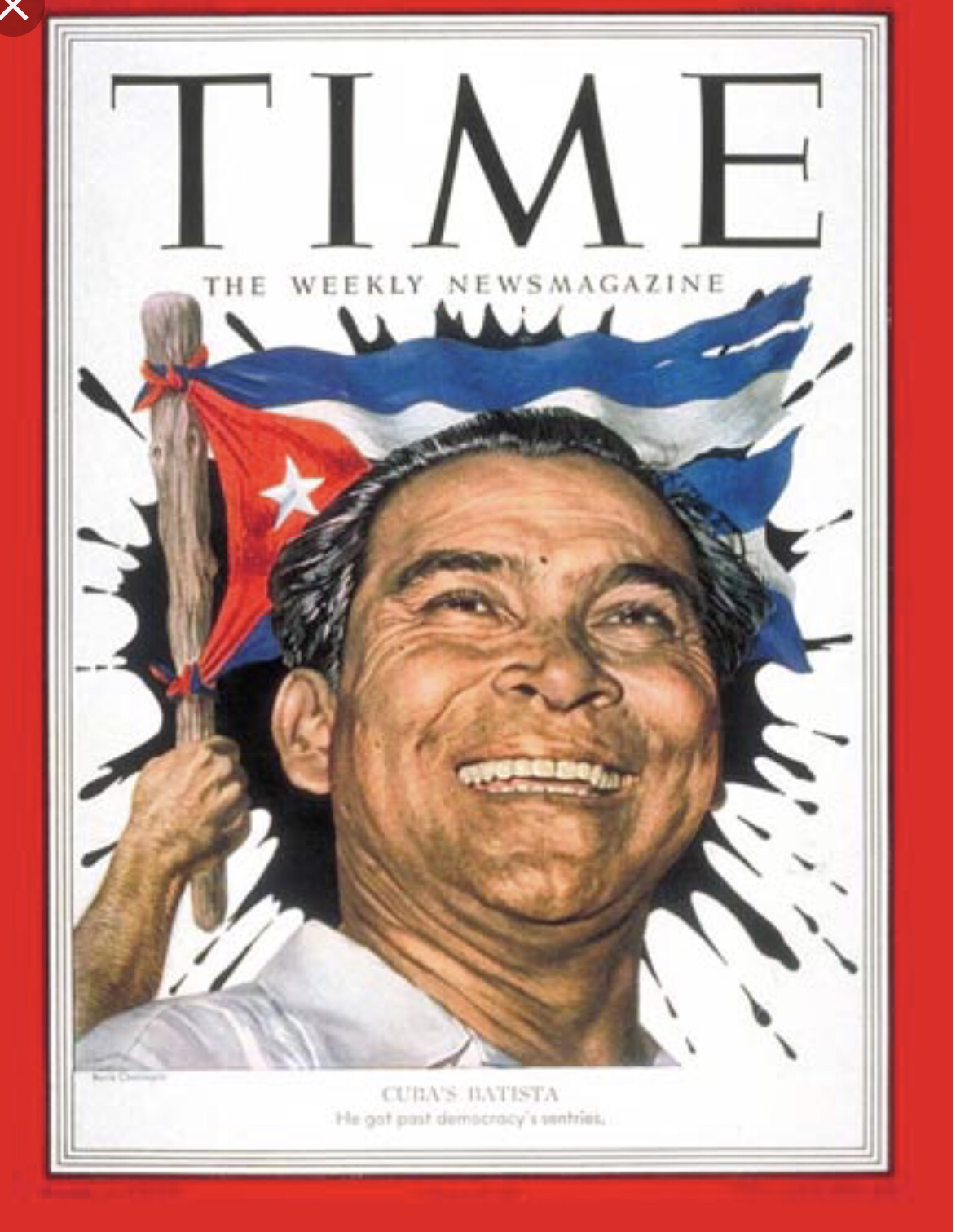
Fulgencio Batista: Betrayed by the United States and Thrown to the Communist Wolves in an Inexplicable Failure of the Eisenhower Administration

Fulgencio Batista made the cover of Time Magazine after his being elected President of Cuba in 1940

He murdered peasants he suspected of disloyalty, ordered mass public executions of thousands of his opponents, dragged long-haired youth off the street and sent them off to work camps, banned free speech and filled the prisons with thousands of those political opponents of his that he didn’t murder outright and his name was Fulgencio Batista? Right?

Wait a minute…hold on…now, I remember…no, no, no – actually it was Batista’s successor who did all of those things and his name was Fidel Castro.

Perhaps if Batista had been as brutal as his successor, Castro, he might have remained in power and ultimately, the people of Cuba would have benefited. He was not – unfortunately for the majority of people living in Cuba. In fact, Batista was rather lenient in dealing with revolutionaries. Exhibit “A,” when the Castro Brothers led their first unsuccessful revolution to overthrow the Batista government, they were sentenced to prison. Later, Castro would summarily (that means without due process of the law) execute people who had done only a fraction of what the Castro brothers themselves had done years earlier. In fact, feeling sorry for the young Fidel and his brother, Batista commuted their sentences and they ended up spending less than two years in prison. That alone, as much as anything, represents the stark differences in styles of governance between Batista and Fidel Castro.

Batista, after winning election in 1940, established a constitution and attracted industries which created jobs for Cuban workers. Before he was illegally ousted from office in a revolution marked by a bloodbath of mass executions, Cubans enjoyed the highest standard of living in all of Latin America. The previous fact is undisputed and documented in numerous studies and comparative economic reports from the era.

So, let’s examine the charges against Batista – shall we?

Charge One: Batista was a dictator.

Yes, although first elected, he did later refuse to step down but he was also fighting a subversive revolutionary force. Oh, I almost forgot, Fidel was also a dictator who, unlike Batista, had never been elected to so much as the office of Dog Catcher. I don’t know, point to Batista on this one.

Charge Two: Batista murdered people.

No, not really. Batista himself disliked the death penalty which is why he spared Castro, and those like him, the first time for trying to overthrow his government – a death penalty offense even in the United States.

Further, the court’s system in Cuba worked quite well under Batista and yes, on rare occasions, people were executed in Cuba while Batista was President. However, these were for horrific criminal acts and ordered by courts of law and not by Batista himself- no mass murder (such as was ordered by Castro) to be found here. What can I say? The point goes to Batista – an easy call.

Charge Three: Evil Batista allowed the establishment of large casinos, hotels, night clubs which a) brought in organized crime; b) encouraged prostitution, and c) exploited the workers.

Really? Those casinos, hotels and clubs filled the tax coffers of the Cuban government and helped provide a largely unskilled Cuban workforce with tens of thousands of jobs. The casinos never measured up to Las Vegas but, they were great and, when combined with the pristine beaches and natural beauty of Cuba, they drew millions of tourists who injected nearly a billion dollars into the Cuban economy – a lot of money in the 1950s.

Organized crime you say? Wow, I’m glad there’s none of that in America. If so, what harm did they do? Prostitution you say? Since the dawn of man, there have been prostitutes. There were and are plenty of prostitutes under the Castro dictatorship – still today. For many women, the meager food rations and allowances afforded them, under Castro’s failed Marxist policies, forced them to prostitution. Yes, kinda like what’s happening today in another failed Marxist country, Venezuela.

Finally the accusations that these casinos exploited workers – really? For many casino workers these jobs were the first substantial incomes they ever earned.

Charge Four: Batista allowed Bell Telephone to come into Cuba and set up a monopoly.

Yes, he most certainly did. Bell Telephone was already a monopoly in the United States and the Cuban telephone system was broken-down and unreliable. Batista wanted to modernize and expand the national telephone network that would allow the county to enjoy a single interconnected telecommunications network like the United States. Yes, Bell Telephone did give Batista a gold plated telephone for his office – oooohhhhhhh! For shame! Of course had there been another private telecommunications company capable of doing this, he might considered them but, alas, there were no others.

Charge Five: Batista had people tortured.

Yes, although not quite on the scale of the United States and it’s allies in the Global War on Terror. Certainly nowhere near the size of scope of the the wholesale torture practiced by Castro.

As the revolution progressed, Castro and his Communist friends began murdering private citizens, engaging in theft on a mass scale and engaging in terroristic acts against private and governmental properties and offices. Some relatively limited torture techniques were successfully used to gain useful information in the Cuban government’s defense against the Communist terrorists. Boo Hoo! The poor little terrorist babies!

What these Cuban officials did, at the time, is a relative drop in the bucket to the wide spread murder and heinous campaigns of torture visited upon Castro’s enemies – real or imagined. Since Castro’s gaining power, torture has been and remains widespread in Cuba. In Havana today, there is a giant steel rendering of Che Guevara’s face. It is affixed to the secret police building where anyone who is even suspected of disagreeing with the Castros may be sent to be tortured or, excuse me, “questioned,” by the secret police. In fact, even daring to attempt escape that little hell hole island, by boat or homemade raft, is enough to get one jailed and tortured – oh, excuse me, I mean “taken into custody and questioned.” If Cuba is such a worker’s paradise, why do on average, Cuban-American exhales, living in the United States, earn 29 times as much as the average Cuban who lives in Cuba? Hmm.

Final Thoughts

After the Castro Brothers overthrew the Cuban Government and executed and or tortured tens of thousands of people, the formerly productive corporate and large, large privately owned farms were seized, broken up, and given to the peasants. Yet, they never produced the same amount of food again and Cuba went from being a net exporter of agricultural products to relying heavily on subsidies from the Soviet Union. The factories stop producing and the Cuban GDP went into a free fall. The casinos were emptied out and many thousands thousands lost their jobs or owned tourist dependent businesses that failed. There was mass unemployment and while everyone received a roof over their head and ration cards, the cities were transformed, almost overnight it seemed, into giant slums.

The entire infrastructure began to collapse as there were no longer enough skilled technicians to keep it going. The beautiful modern phone network set up by Ma Bell was mostly dismantled. Fidel didn’t like the idea of widespread phone availability as the phone lines could been used to coordinate resistance to the Castro dictatorship just as the communist rebels had used them against Batista.

Liberals like to blame Communist Cuba’s economic downfall on the United States Embargo. How convenient? The problem was and is that liberals are unwilling to accept the fact that the Cuban system failed not because of the US but because, in the most simplistic of terms, Communism just doesn’t work. It never ever has and never will.

Perhaps liberals have never been able to except the failures of Communism because well, Communism is just a little too close to their own flawed ideology.. Don’t believe me? Go ahead and ask a liberal to explain why Communist country “X” (take you pick) failed? Then, watch them with true knee jerk speed say, “Well, County “X” was never really a true representation of proper socialism.” Go ahead and try it out on a liberal. It works every time.

Felix Rodriguez: The Man Who Took Down Che Guevara

IMG_1289-0.JPG

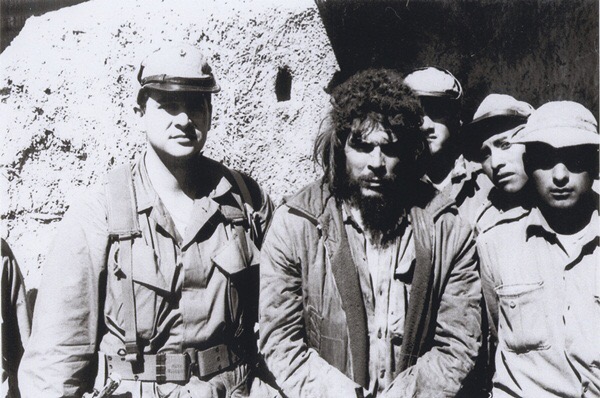
Felix Rodriguez, pictured above on the left next to Che Guevara, is a Cuban exile turned U.S. Citizen, and a personal friend of President George H.W. Bush. Rodriguez is also a highly decorated former U.S. Soldier and CIA Operative. He is perhaps best known for his role as the CIA operative responsible for the capture of Che Guevara. Rodriguez successfully fled Cuba during the blood bath following Communist dictator Fidel Castro’s violent overthrow of President Fulgencio Batista. However, most of Rodriguez’s family, including his father and two brothers, were murdered by Castro’s Communist henchmen in Cuba. It’s likely that Che Guevara played a role in most, if not all of the Rodriguez family executions. In the end, like many others, they were murdered merely for being wealthy.

Seeking revenge for the murder of his family and many friends, Mr. Rodriguez soon joined and became a leader in the CIA backed “Operation 40” and “Brigade 2506.” These groups were part of the United States plan to overthrow the Castro regime by training and equipping a Brigade of Cuban exiles to invade their homeland – later becoming known as the “Bay of Pigs invasion” during the Kennedy administration. Felix Rodriguez played a key role in the ill-fated invasion as he volunteered for the highly dangerous assignment clandestinely infiltrating Cuba a couple of weeks prior to the actual invasion in order to gather critical intelligence which was used in the planning and preparation for the invasion. Unfortunately, his bravery was for not as President Kennedy would later backtrack on using U.S. combat aircraft for the crucial air support which was needed for the invasion to succeed.

In addition to those killed, some 1200 Cuban exiles were taken prisoner and virtually all were tortured – some executed. Again, the driving force behind the executions and torment was Comrade Che. Felix Rodriguez could never have imagined then, that some six years later, he would be in a unique position to settle scores with the Red Butcher, Che Guevara.

The Chickens Come Home to Roost

Che was never an accomplished battlefield tactician during the Cuban revolution. After that revolution, when given the task of industrializing Cuba, he failed miserably. His subsequent revolutionary adventurism in Africa was equally ill fated. The only thing Guevara was really accomplished at was murdering others. During the revolution, Castro promoted him not for his brilliance as a military strategist or for his leadership abilities but rather, because Che had no qualms with murdering those who Castro asked him to kill. Whenever a local peasant refused to cooperate with Castro’s men or objected to the guerillas taking his crops or, for that matter, was suspected of talking to government forces, Comrade Che was always more than happy to do the dirty work that most of the others in Castro’s rag tag army would not do. Even after Che was promoted to a leadership position in the guerilla movement, he left the tactical planning of operations to some of his otherwise more competent subordinates.

As mass executions in Cuba began to slow to to a trickle, Che began to contemplate his future. His failures in other administrative duties of state caused Castro to lose confidence in his ability to play a significant role in the new Communist government. With little future in Cuba, Che decided it was time he lead a new revolution in South America. He picked Bolivia, one of the poorest countries in South America, because it bordered five other countries which, so he thought, would afford an insurgent force like his own the opportunity to train and set up camps just outside of Bolivian territory. He foolishly assumed that because Bolivia was lacking in natural resources, the United States would be less inclined to assist the Bolivian government. His assumptions were wrong.

By 1967, Felix Rodriguez was rising star in the CIA’s Special Activities Division. He was considered the agency’s top field operative for Central and South America. It was, in a sense, poetic justice of sorts when Rodriguez was chosen to be the CIA’s point man in the search for Guevara. When intelligence reports indicated that the Red Butcher was operating in Bolivia, Rodriguez was sent down to coordinate the effort to find and take him out. As a cover, Rodriguez wore a Bolivian Army uniform and assumed the rank of a Major in that Army. Rodriguez, along with Bolivia’s 2nd Ranger Battalion, which had been trained by U.S. Special Forces, moved into action near the Yuro ravine on October 7, 1967 after a deserter from Che’s guerilla force went to the authorities and informed them of Che’s whereabouts.

In a glaring violation of Operational Security, Che failed to relocate his force of some fifty rebels from their encampment after knowing that one of his men had deserted. Accordingly, Che and his men, whom Che had positioned in a depression with high ground on all sides of them, were attacked the next day by the Bolivian Rangers and Alex Rodriguez. In addition to placing his men in the worse possible tactical position, with no means of escape, Che failed to position sentries on the perimeter of his encampment. As a result, Che’s group was taken completely by surprise while finding themselves without any prospect of retreat, thanks to Guevara’s shocking incompetence. It was a turkey shoot for the Bolivian soldiers who rained hot lead down upon Che and his hapless followers.

While Guevara lacked the competence to adequately train or lead his doomed rebels, he had successfully engrained onto their impressionable psyches that they must never surrender. Che repeatedly urged his followers to “fight to the last breath” and to “save the last bullet” for themselves. When the Bolivian Rangers attacked them on October 8, 1967, that is exactly what his men did.

Despite being poorly equipped and led, Guevara’s men fought on in an impossible situation. As Guevara’s rebels courageously followed his directive to “fight to the last drop of blood” and while being mercilessly gunned down, Che made a run for it! Guevara simply bolted away from his men in the heat of battle. While his men bravely fought on, Guevara managed to climb out of the depression and dart out into the open. As two Bolivian Rangers leveled their weapons at him, Guevara dropped his own fully functional rifle, with a near full magazine, and begged, “Don’t shoot! Don’t shoot! I am Che Guevara and I am worth more to you alive than dead!” As his small guerilla force was being decimated below, in the very trap he had led them into, Guevara’s only concern was for himself as he continued to plead with the Bolivian Rangers not to kill him.

Separating Che Fact from Che Fiction

Che’s life as a Marxist Revolutionary has been romanticized by the American Left for decades. The Left, while conveniently overlooking his well documented history as a bloodthirsty mass murderer, has chosen to present him as a courageous type of Robin Hood who gallantly took up the fight for the poor against those who he perceived as the exploiters of the poor. This revisionism has been quite successful. Hollywood movies extol Che’s noble struggle against these so called oppressors of the weak. It is now chic to wear clothing which displays his image. Also, certain pseudo historians have tried to portray Che as a selfless, ultra-brave, larger than life military genius. The problem is that none of it is true.

Che, it is said by some of his admirers, only surrendered after being “wounded in both legs and having his rifle rendered inoperative by an enemy bullet.” The truth is that at the time of Che’s cowardly and hypocritical surrender, he had only a minor flesh wound from a bullet that passed cleanly through a small portion of his lower left calf muscle. This superficial wound, more akin to a nick, likely occurred while he was running away and only caused him to limp slightly as he surrendered to the Bolivians. He was later seen walking that day by others and again, the next day, in village of La Higuera. He also apparently had no problem walking outside of the schoolhouse, that he was being kept in, the following day where he posed with Rodriguez, for the photo above. The minor wound on his calf was dressed and treated with a bandage. The “seriously wounded in both legs” story is a fiction promulgated by his Leftist, crypto-Marxist admirers within American academia and media circles.

Perhaps even less credible is the odd fiction of Guevara’s rifle having been “rendered inoperative by an enemy bullet.” Statements from the Bolivian Rangers indicated that not only was Guevara’s rifle fully operational but he had a near full magazine of ammunition. If these facts were not enough, upon surrendering to his Bolivian captors, they found a fully loaded Walther PPK pistol on his person – also with a full magazine of ammunition. As Guevara cooperated fully with his captors, by offering his hands up to be tied by the soldiers, his erstwhile comrades were fighting on and dying – following his admonishment to “fight to the last breath.”

Yet, what shocked the Bolivian soldiers and Felix Rodriguez more than Che’s sissified desertion of his men and surrender was the strange whimpering and ingratiating manner he took on with his captors after surrendering himself.

“What’s your name,” a cooing Guevara asked of one of the young Bolivian Rangers after his capture. “What a lovely name for a Bolivian soldier,” Che said with a smile.

After meeting Captain Prado, a company commander in the Bolivian Rangers, a chatty and overly ingratiating Guevara beamed, “you are a very special person Captain. I have been talking to some of your men and they think very highly of you.”

Che, the medical school dropout, inquired of his captors, upon seeing a wounded Bolivian soldier, “Shall I attend to (medically treat) him?” The Red Butcher, suddenly humbled and keenly aware that he was not the man portrayed in the fawning news clippings written by his liberal admirers, began chatting away through a nervous smile to anyone who came near him. “What will you fine and brave men do with me? I don’t think you want to kill me as I am much more valuable to you alive,” Che whimpered to Rodriguez.

“Now please tell me what you intend to do with me? I can be quite helpful to you!” Guevara continued to whine, beg and persuade the Bolivians and Felix Rodriguez to spare his life. While doing this he never once expressed any interest in or concerns regarding the fate of his guerilla comrades- those foolish and naïve souls who agreed to follow him and who ultimately died for him.

Che Goes Out with a Whimper

Che spent the evening tied up inside a school house in the village of La Higuera as his fate was being decided by the civilian and military leadership of Bolivia. On October 9, 1967, the coded order came in on the radio. Che was to be executed. Surprisingly, Felix Rodriguez, who lost most of his family at the hands of Guevara, magnanimously argued that the bumbling revolutionary’s life should be spared. Rodriguez wanted him taken to Panama where he could be questioned by the CIA. Yet, the Bolivians would have nothing of it. The Red Butcher was to receive his comeuppance and the world would be free of this bloodthirsty terrorist.

When the call for a volunteer to execute Guevara was made throughout the ranks of the 2nd Ranger Battalion, virtually ever Bolivian soldier stepped up to perform the task. In the end, the honor was given to a Sergeant who saw three of his soldiers killed in action during the battle.

There have been many different fictitious accounts floated as to what happened when that Sergeant entered the school house to execute Guevara. Most of these have Guevara defiantly and courageously taunting his executioner. Some of these accounts have included fabricated quotes and descriptions which are alleged to have come from the Sergeant. These purport to be what he heard and saw immediately before Guevara’s swift and humane execution.
In reality, Guevara’s executioner had spoken very little as to what transpired in that school house. He believed that even the death of a monster like Che deserved at least a modicum of dignity. What has been made clear for decades is that in the moments before his execution, Guevara was a broken, teary eyed, whimpering man who silently lowered his head the moment before the trigger was pulled. In an instant, Guevara was no more. His was a quick and painless death. It was the merciful type of ending that was denied most of the many thousands of his victims. Knowing that Rodriguez’s family had murdered by Che, the Bolivian Army officers at the scene, presented Felix with Guevara’s Rolex wristwatch. He still proudly wears it on his wrist to this day.

Rodriguez Continues in his Service to America

Felix Rodriguez went on to a distinguished career in the CIA. Two years after the death of Che he would volunteer for combat duty in Vietnam. There he flew over 300 combat missions and was shot down five times. His awards and decorations are numerous and include the very rarely awarded CIA Intelligence Star for Valor and nine Crosses for Gallantry by the South Vietnamese Government among many others. Rodriguez continued to serve in the CIA through most of the 1980s. Today, he lives in Miami and is a respected leader in the Cuban American Community.